
Regeneratively farmed barley
Regenerative agriculture is a holistic approach to farming that works to benefit both the environment and the farmer. Utilising a selection of farming methods regenerative farming strives to improve yields, enhance soil health, support biodiversity and reduce the CO2 emissions from farming.
Healthier soil can retain water better and support crop growth, reducing the need for fertilisers, chemicals, and irrigation. This in turn can lower input costs and increase the fields’ resilience to drought and extreme weather conditions. Over time, these practices may benefit farmers through more stable yields, better crop quality, and improved profitability.
Long-term collaboration with the Baltic Sea Action Group
Barley is a key ingredient of Anora’s grain spirit distilled at its Koskenkorva Distillery. In 2025, Anora purchased around 165 million kilos of Finnish barley, representing approximately 15% of the barley yield and 34% of the total share of barley sold in Finland, making Anora one of the largest buyers of Finnish barley. As such an important raw material, barley farming constitutes a significant part of Anora’s Scope 3 (value chain) emissions.
Anora works together with the Baltic Sea Action Group to promote and support farmers in adopting regenerative farming methods with the aim of reducing emissions and combating climate change. Improved soil health can also reduce the flow of nutrients into waterways helping to reduce the eutrophication of the Baltic Sea. In 2025, we renewed our Baltic Sea Commitment, first signed in 2018, for 2026–2030. Together with BSAG, we will continue to provide training and resources to our farming partners.

Regenerative farming criteria
BSAG has created the criteria for regenerative farming in partnership with companies, researchers, and farmers in their Carbon Action platform.
Based on BSAG’s criteria, regenerative farming means:
Continuous development of competencies and operations
Purposefully improving and maintaining soil health
Reinforcing biodiversity above and below systematically
Diverse crop rotation
Maximising all-year-round, living vegetation cover
Minimising tillage (soil cultivation)
Utilising nutrients based on plant needs and relying on organic fertilisers and biological nitrogen fixation
Minimising the use of plant protection products
Anora’s agreements with contract farmers are based on these criteria.
Read about regenerative farming in more detail from the website of the Baltic Sea Action Group (BSAG).
We use barley grown with regenerative farming methods in our Koskenkorva flagship vodka but also in other Koskenkorva products. Our target is to increase the share of regeneratively farmed barley used in our own grain-based spirits to 30% by 2030.
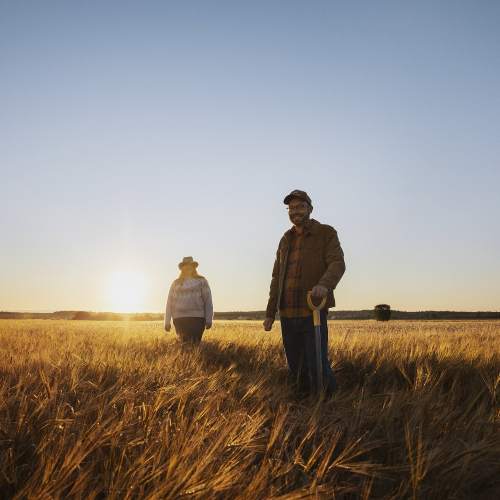
Regenerative farming for the climate, from the Aila-Korpela farm to Koskenkorva distillery
Anora aims to increase the use of regeneratively farmed barley in spirit production. Regenerative farming is a selection of farming methods that improve yields and help reduce the CO2 emissions. Veli-Pekka Aila is one of Anora’s contract farmers who, together with his wife Noora, has transitioned to using regenerative farming practices.